Experiment Design
General Information
Nuclera uses an E. coli based cell-free blend to express proteins both on the cartridge and as you scale up to larger volumes for various downstream applications and assays. This expression system retains the speed and efficiency of microbial E. coli expression, but removes the complexity and difficulty associated with working with living biological systems.
Which additive can be used
Nuclera Standard Additives
Uniquely, we have designed our cell-free blend to be tailorable and customizable through the addition of up to two additives that can be used to further optimize expression of your proteins in our system. See a list of our standard additives below:
| Additive | Additive Description | Additive Characteristics |
|---|---|---|
| Additive buffer | HEPES buffer pH 7.5 and surfactant | CFPS reaction buffer, dilution normalization |
| PDI + GSSG Mix | Protein disulfide isomerase and oxidized glutathione | Chaperone and redox modification to oxidizing environment to support disulfide bond formation |
| TrxB1 | Thioredoxin reductase | Protects proteins from oxidative aggregation and inactivation and acts as a reductase in redox regulation |
| DnaK Mix | Chaperone | DnaK mix Chaperone mix to support folding and prevent aggregation |
| Zinc chloride | Zinc chloride solution | Cofactor that can be required for folding, stability, or activity |
| Calcium chloride | Calcium chloride solution | Cofactor that can be required for compaction, folding, stabilization, or activity |
| Manganese chloride | Manganese chloride solution | Cofactor for metalloenzymes for structure and activity |
| Cofactor Mix | Mix of NAD, acetyl CoA, FAD, SAM, and PLP | Cofactors that assist in folding, stability and activity |
| GSSG | Oxidized glutathione | Redox modification to oxidizing environment |
| 3C protease | 3C protease solution | Protease to cleave off the N-terminal solubility tag at the specific aminoacid sequence (LEVLFQ/GP) |
Custom Additives
Need a custom additive not provided by Nuclera? Nuclera also offers guidance for you to make your own additives to test on the eProtein Discovery™ system. See our Custom Additives Guide for more information.
Nanodiscs Selection Guide
For membrane proteins, one stabilizing custom additive (e.g., a nanodisc, which mimics lipid bilayers to support proper folding and function) should be selected, along with either an additional additive from Nuclera's standard additive panel or another compatible custom additive.
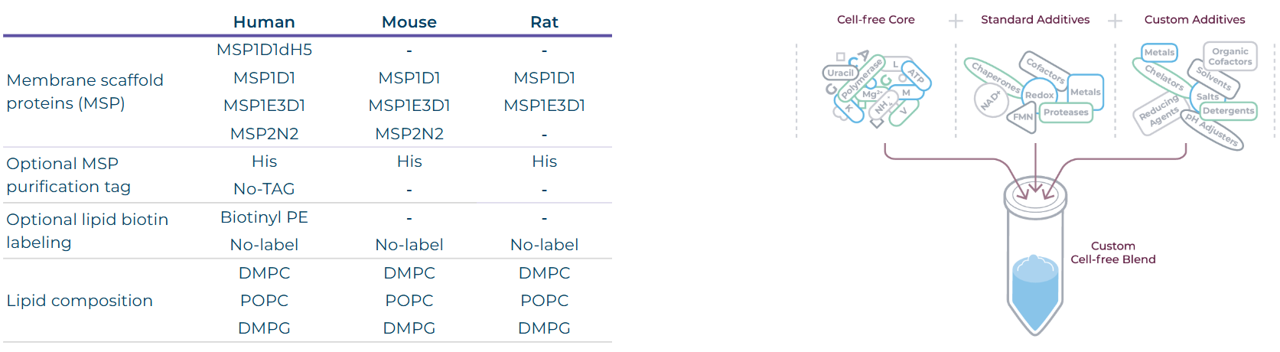
If the membrane protein is required for immunization, select the appropriate species. If not, Human should be used. Alternative nanodiscs not listed can also be screened, but please consult our Chemical Compatibility guide or contact our technical support team at techsupport@nuclera.com for guidance.
Step 1: Select a membrane scaffold proteins.

Step 2: Select between optional tags.
- His-tagged or untagged membrane scaffold proteins for ease of purification if assembling own nanodiscs.
- Preassembled nanodiscs with biotin labeled phospholipids for SPR.
Step 3: Select a phospholipid.

Nanodiscs can be added to any of the Standard Nuclera additives. To choose which additional additve to use follow the flowchart reported in the figure above.
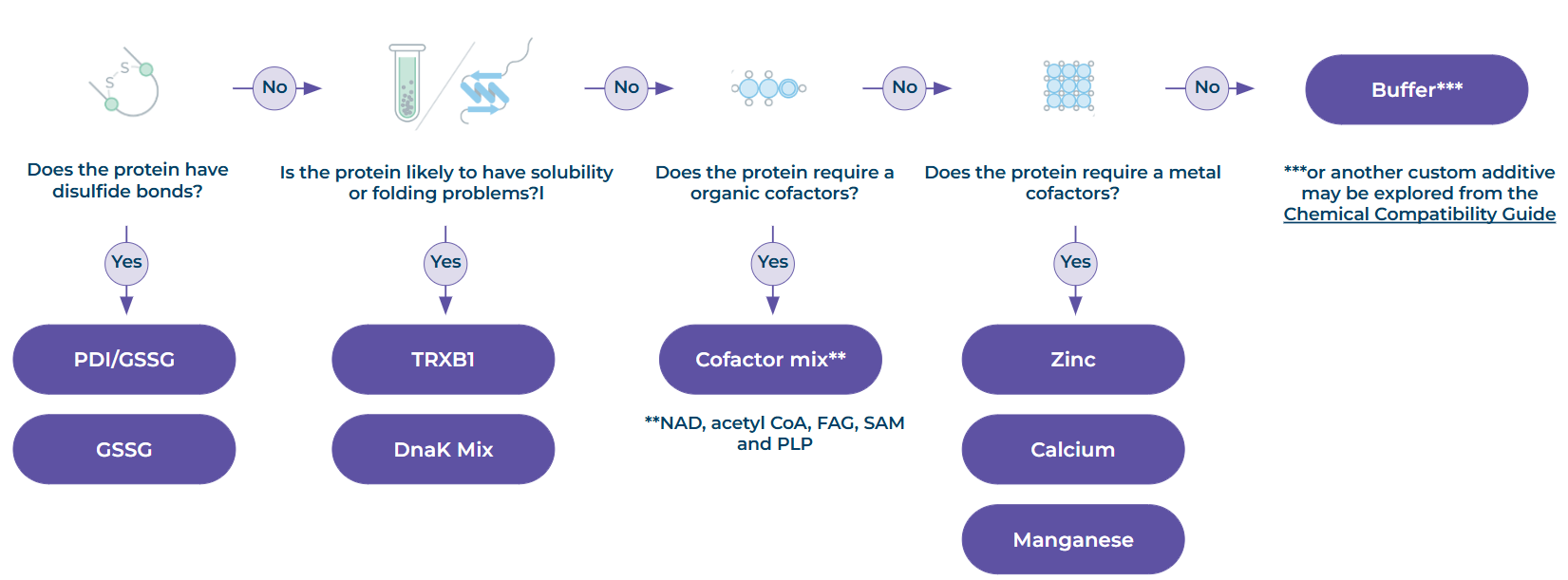
Choose the right combination
How can you choose which combiantion suits your experiment the best? Follow the flow chart report in the image below. If you need any suport do not hesitate to contact our Nuclera Technical Support team at techsupport@nuclera.com
Nuclera Technical Support:
UK Phone +44 1223 942 761
US Phone: +1 508-306-1297
Email: techsupport@nuclera.com
Offices:
Nuclera UK (HQ):
One Vision Park, Station Road, Cambridge, CB24 9NP, UK
Nuclera USA:
1000 Technology Park Drive, Suite B, Billerica MA 01821, USA
Copyright © 2025 Nuclera Ltd. All trademarks are the property of Nuclera, Ltd. Visit nuclera.com/legal for more info.